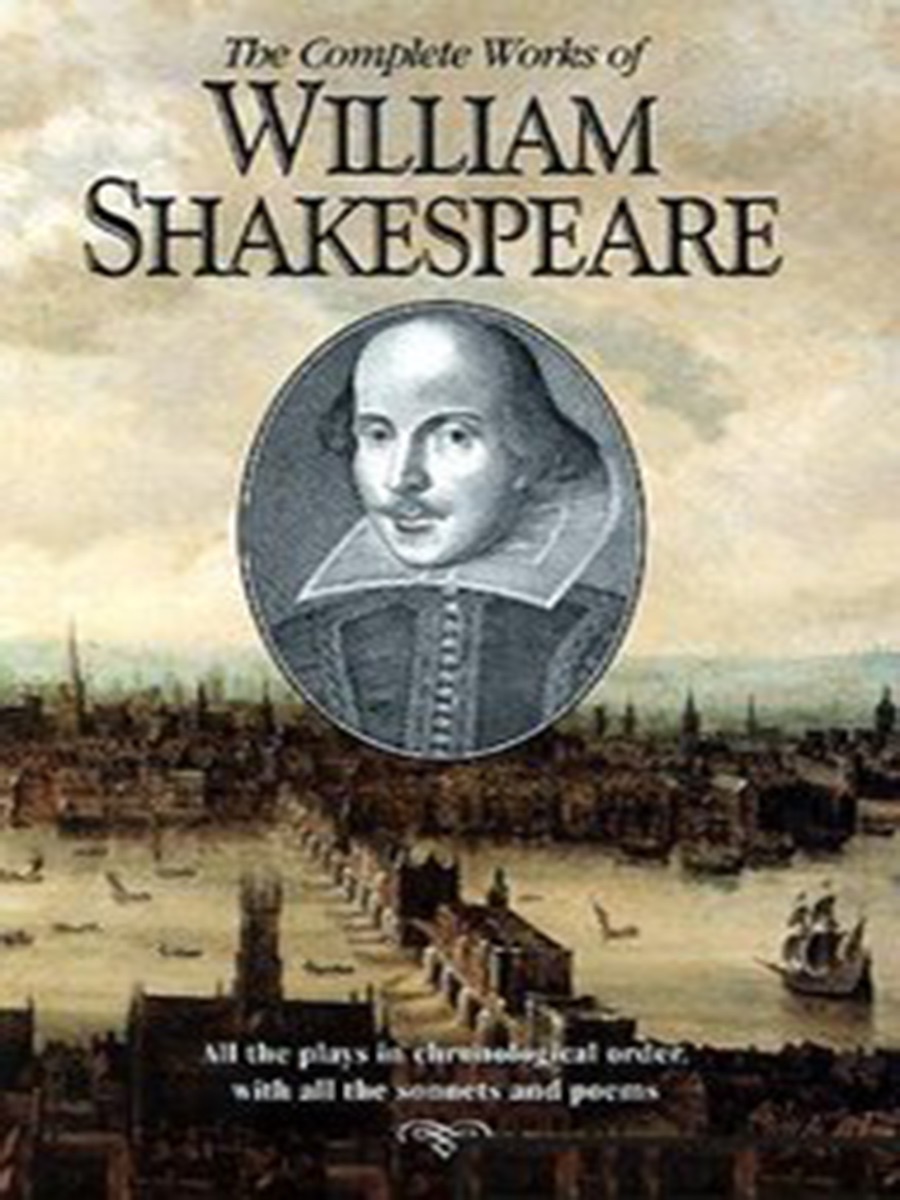
Why this book
This is not a plot but a library: comedies, histories, and tragedies, drafted for London's Globe stage, first collected complete in 1623 by two of Shakespeare's own actor-friends, seven years after his death, so the plays would survive beyond memory and worn playhouse scripts.
The Story
The first tale: Hamlet. In Denmark's cold castle, a prince mourns his father the king, dead only two months, while his mother Gertrude has already remarried, to his uncle Claudius, who now sits on the throne.
A ghost walks the castle ramparts at midnight in the old king's armor and tells Hamlet the bitter truth: Claudius murdered him in his sleep, pouring poison into his sleeping ear in a garden.
Hamlet swears revenge, then hesitates — is the ghost honest, or a devil testing his soul? He feigns madness to buy time, watching his uncle's face for the guilt that would prove the ghost right.
He stages a play that mirrors his father's murder before the whole court; Claudius bolts from his seat, guilt exposed. But Hamlet delays again, and later kills Polonius by accident behind a curtain, mistaking him for the king.
Ophelia, Polonius's daughter and Hamlet's love, drowns in madness and grief after her father's death. Her brother Laertes returns from abroad for vengeance, and Claudius quietly arms him with a poisoned blade for a staged duel.
In the final duel, blades and a poisoned cup change hands in the chaos. Laertes wounds Hamlet with the poisoned foil, and Queen Gertrude unknowingly drinks the poisoned wine that Claudius had meant for her son.
Hamlet, dying, finally strikes Claudius down with the poisoned blade. Within minutes Hamlet, Laertes, Gertrude, and Claudius all lie dead, and the throne passes to a foreign prince, Fortinbras, who arrives to find the court emptied.
As Shakespeare wrote, 'To be, or not to be, that is the question' — Hamlet's hesitation is the play's true subject, a mind at war with itself long before any sword is finally drawn.
The second tale: Romeo and Juliet. In Verona, two families, Montague and Capulet, have feuded so long that even their servants brawl in the streets over nothing but old, inherited hatred.
At a masked Capulet ball, Romeo Montague sees Juliet Capulet across the room and falls instantly in love; she feels the same, not yet knowing his name belongs to her family's sworn enemy.
They marry in secret the very next day, with only Friar Laurence and Juliet's nurse aware, hoping their union might one day quietly heal the feud dividing both their households.
Tybalt, Juliet's cousin, kills Romeo's close friend Mercutio in a street duel. Romeo, enraged with grief, kills Tybalt in return and is banished from Verona for the killing that same afternoon.
Juliet's father, unaware of her secret marriage, arranges her wedding to Count Paris. Desperate, Juliet takes a potion from Friar Laurence designed to mimic death for exactly forty-two hours.
The friar's warning letter to Romeo never arrives in time. Believing Juliet truly dead, Romeo buys poison from an apothecary and returns to her family tomb, unwilling to live without her.
Romeo drinks the poison beside Juliet's body just before she wakes. She stirs moments later, finds him dead beside her, and stabs herself with his dagger rather than face life alone.
The third tale: Macbeth. On a windswept Scottish battlefield, three witches greet the victorious general Macbeth with a prophecy: he will be Thane of Cawdor, and after that, king of Scotland.
The first prophecy comes true within the hour. Macbeth writes to his wife, Lady Macbeth, who resolves at once that fate could use some help: King Duncan, their royal guest, must die.
Duncan visits Macbeth's castle as an honored guest. That night, urged on by his wife's ambition, Macbeth murders him in his sleep and frames the king's drunken, unwitting guards for the crime.
Crowned king, Macbeth cannot rest easy. He hires killers to murder his friend Banquo, whose descendants the witches had promised would inherit the throne instead of his own line.
Banquo's ghost appears at Macbeth's own banquet table, visible to no one else in the hall; Macbeth's terror in front of his gathered lords begins to unravel the crown he murdered for.
Lady Macbeth, consumed by guilt, sleepwalks nightly trying to wash invisible blood from her hands, and eventually takes her own life, unable to carry the weight of what they both did.
The witches promise Macbeth safety until a forest marches to his castle and no man born of woman can kill him — riddles he trusts far too literally, and far too late.
Malcolm's soldiers disguise themselves with cut branches, fulfilling the forest's march on the castle; Macduff, delivered by a birth the prophecy never covered, kills Macbeth and restores Duncan's rightful line.
The fourth tale: A Midsummer Night's Dream. In Athens, four young lovers flee into an enchanted forest to escape a father's demand and a law that could cost one of them her life.
The forest belongs to Oberon and Titania, king and queen of the fairies, mid-quarrel over a stolen human child; Oberon sends his mischievous sprite Puck to fetch a magic flower.
The flower's juice makes anyone fall in love with the first living thing they see on waking. Puck, meaning to help the mortal lovers, doses the wrong sleeping man by mistake.
Chaos follows: both young men now love the same woman, mocking the one they'd loved the night before, while Titania wakes and falls in love with a weaver wearing a donkey's head.
By morning, the lovers wake in the forest unsure if the night was even real, now correctly paired, and return to Athens together for a joyful joint wedding celebration at court.
The fifth tale: King Lear. An aging king decides to divide his kingdom among his three daughters, asking each to declare how much she loves him before he gives up his crown.
Goneril and Regan flatter him with extravagant, hollow speeches; Cordelia, his youngest and most honest daughter, says only that she loves him as a daughter should, no more and no less.
Enraged by what he hears as coldness, Lear disowns Cordelia and splits her share of the kingdom between her sisters, keeping for himself only a hundred knights and his royal title.
Once in power, Goneril and Regan strip their father of his knights and his dignity, turning him out into a raging storm on the heath with nothing but a fool for company.
Lear's mind breaks under the storm and the betrayal; in a parallel plot, the loyal Earl of Gloucester is blinded for helping the king, betrayed by his own scheming son Edmund.
Cordelia returns from France with an army to save her father. Father and daughter reconcile in a quiet, tender scene, just before their gathered forces are defeated together in battle.
Cordelia is hanged in prison on Edmund's order before the truth of the battle's outcome reaches her jailers in time. Lear carries her body onstage, refusing to believe she will not wake.
What it means
Their deaths finally end the feud: Montague and Capulet meet over their children's bodies and swear peace at last, the price of hatred paid in the two things they loved most.
Puck steps forward alone at the very close and tells the audience directly: if this shadow-play has offended, think it all merely a dream — a wink passed from stage to seats.
Lear dies of grief over Cordelia's body, and the kingdom is left to be rebuilt by the survivors — the storm's cruelest lesson, that honesty was love all along, unheard until too late.
Elsewhere on the shelf: Othello is destroyed by a jealousy a villain plants in his ear; Twelfth Night's shipwrecked twins spark a comedy of mistaken identity; The Tempest's exiled sorcerer forgives the men who wronged him; Much Ado About Nothing's sharp-tongued rivals are tricked into falling in love.
Julius Caesar falls to friends who call the murder mercy; Richard III schemes and jokes his way to a crown he cannot keep; Henry V rallies outnumbered troops before Agincourt with a single speech; The Merchant of Venice hinges on a pound of flesh and a court's mercy.
As Shakespeare wrote in As You Like It, 'all the world's a stage, and all the men and women merely players' — a line from a comedy of banished dukes and a forest full of disguises. Antony and Cleopatra choose love over empire and lose both; Coriolanus falls for scorning the crowd he needed.
The Winter's Tale forgives a jealousy sixteen years old when a statue seems to breathe; Titus Andronicus spares no one in its revenge; the Sonnets turn love, time, and mortality into fourteen lines each; Venus and Adonis and The Rape of Lucrece prove the poet's reach beyond the stage.
Across comedy and tragedy alike, the same truth repeats: ambition without restraint destroys itself, love tested by pride or misunderstanding costs the most, and forgiveness, when it finally comes, arrives too late to undo the damage, but always in time to mean something.
🎧 Read-along audio is being prepared — text-only for now.