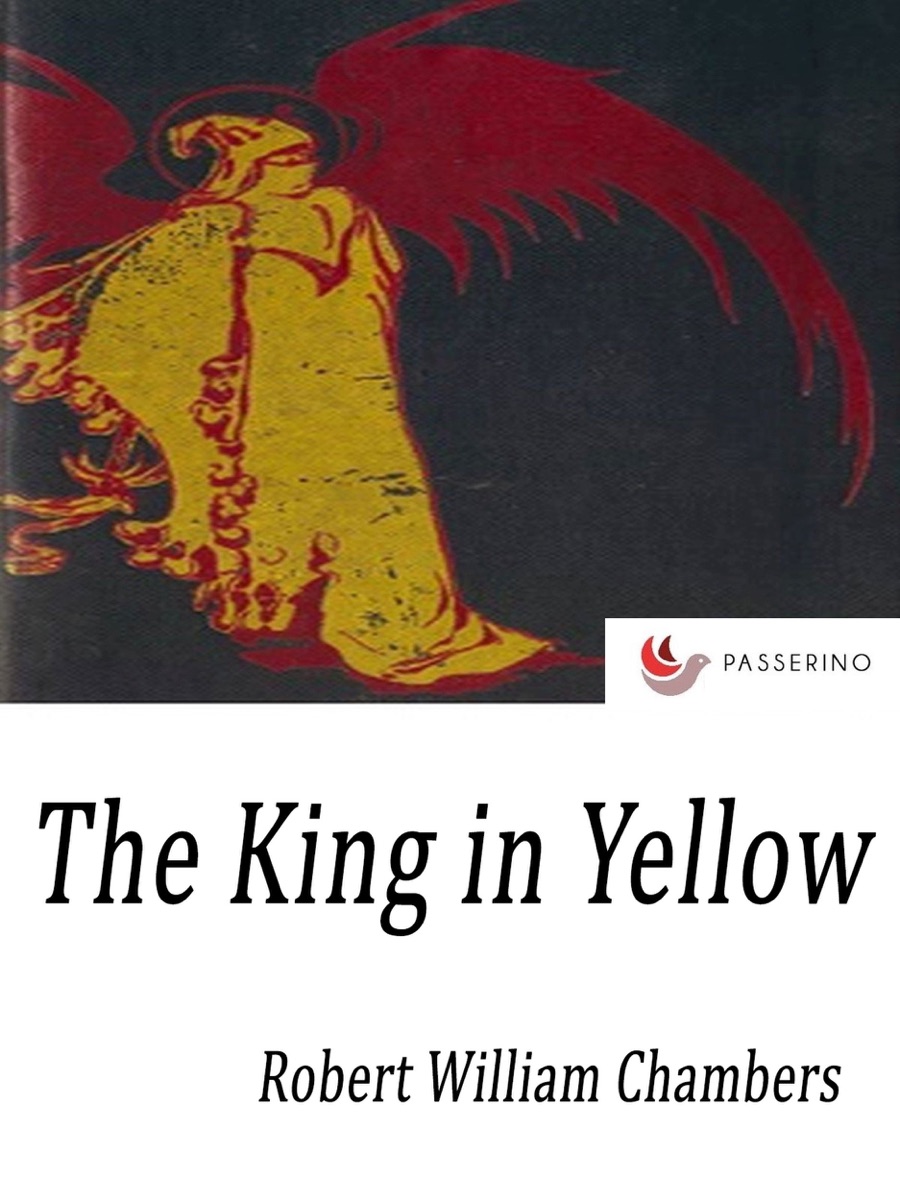
Why this book
This mythology is entirely Chambers's own invention — no ancient manuscript exists, no real play was ever staged, yet he built the legend so convincingly that generations of readers half-believed it. Critics of the day called the collection decadent and morbid; the public read it anyway, hungry for its shadowed, cosmic dread.
The book outlived its author's own fame: it seeded H. P. Lovecraft's cosmic horror a generation later, lent its very title to a television series a century after that, and taught fiction a lasting lesson — that a story can haunt a reader precisely by refusing to reveal the thing it hides.
The Story
The first tale: Hildred Castaigne, our narrator, has read the play's second act and can no longer separate delusion from destiny. He believes himself heir to a hidden American throne, and his only ally is Mr. Wilde, a crippled blackmailer who keeps a secret ledger naming five hundred terrified victims.
Wilde shows a coerced embezzler named Vance the 'Imperial Dynasty of America,' a manuscript naming Hildred king, and Vance is pulled fully into the plot. Meanwhile Hildred's cousin Louis, engaged to Constance Hawberk, announces his coming marriage and his transfer to San Francisco — a plan Hildred flatly forbids, claiming imperial authority over him.
Hildred arms Vance with a knife and a sketched plan of Hawberk's apartment, meaning for him to kill both Hawberk and Constance — but Vance is instead swept into the Lethal Chamber, the city's legal suicide parlor, and vanishes from the story entirely, his fate sealed by Hildred's spiraling madness.
In the end Hildred dons a golden crown and the sign-marked yellow robe, and proclaims himself King in the empty dark of his own house — the book never once tells us whether this is triumph, total delusion, or the two grown at last completely indistinguishable from one another.
The second tale: the painter Mr. Scott and his model Tessie Reardon are haunted by her recurring dream of a hearse and a bloated, decomposed driver. Scott dismisses it as fancy — until a friend confirms that the real night-watchman outside has turned up rotting in an alley, and missing a finger.
Against every warning, Scott and Tessie read the play's forbidden second part together late in his studio, and the words settle into them like a slow fever — the world outside grows thin and unreal, while the story's hidden truths feel more solid than the very room they sit in.
Then the hearse-creature comes to collect what it is owed: it claws its way up to Scott's coat and tears free the onyx clasp shaped like the Yellow Sign — the one small talisman that had marked them both as already claimed by the thing they dared to read.
Both Scott and Tessie die that same terrible night, and the story leaves no comfort behind it at all — the Yellow Sign, we learn too late, was never a blessing or an honor, only a mark stamped on the doomed, fatal the instant it is noticed by its bearer.
The third tale: the sculptor Boris Yvain discovers a strange solution that turns living things to stone in a single instant — no death, no decay, only cold marble, perfect and still. He and the painter Alec test it first on a lily, then a goldfish, then a rabbit.
Both men love Geneviève, but her heart turns slowly toward Alec, and the strain destroys all three of them completely: grief-stricken, Geneviève drowns in Boris's own petrifying basin one night, and Boris, unable to bear what his invention has caused, turns his pistol on himself before dawn.
Alec flees Paris for two grief-worn years, until his old friend Jack's anxious letters finally pull him back to the very studio he once abandoned — and there, astonished, he finds the marbleized lily and goldfish and rabbit, one after another, quietly stirring back to unexplained, impossible life.
Last of all, Geneviève herself stirs within the marble — the curse, it turns out, was never permanent, only patient, waiting out its hour. The tale that began in grief and death ends, against every reasonable expectation, with a slow and trembling return to breath and warmth.
The fourth tale: a lost hunter named Philip wanders the misty Breton moors and stumbles into the timeless world of Jeanne d'Ys, a noblewoman with falcons and hounds who quietly takes him in — and between them, almost at once, something older than either of them recognizes love.
Philip lingers on in her strange, unchanging household, never quite noticing that nothing around him seems to age or alter, until the two of them embrace beneath an old and twisted tree — and a viper, coiled hidden in the grass, strikes him without any warning at all.
Philip wakes alone to find the château fallen to ruins, centuries older than it stood the evening before, and learns from a passing peasant that Jeanne d'Ys died in the year fifteen seventy-three, for love of a stranger who was also, impossibly, named Philip, just like him.
What it means
The only proof any of it happened is left waiting on her shrine: a single glove, warm and fragrant as though worn only moments ago — the tale's one aching relic of a love that crossed three hundred years to find its stranger again, and lose him once more.
Beyond these four, the collection sweeps wider still. In 'The Court of the Dragon,' a man dozes through a church sermon and wakes pursued through the streets of Paris by a pale organist bent on killing him — reason never explains why, and the chase itself becomes the whole horror.
Then the book turns from horror to wartime Paris under siege: in 'The Street of the First Shell,' the painter Severn mourns a dead love remembered only through a cat; in 'The Street of the Four Winds,' Jack Trent survives the siege entirely and finds Sylvia waiting, child and all.
Trent learns the child is not his own but a spy's, fathered before their marriage began — and forgives it completely, pleading even for the spy's own life, simply because Sylvia asked him to; the story trusts love to outlast a secret rather than break apart because of one.
In 'The Street of Our Lady of the Fields,' Hastings quietly courts the model Valentine Tissot amid easels and studio gossip; and in 'Rue Barrée,' Clifford and his rival Selby both chase the guarded affections of a young art student who answers to absolutely no one but herself.
Selby buys her a small rose-bush; she wears one of its roses, and in time returns that very same flower back to him — a small, wordless gesture the notes leave as the whole of their answer, neither triumph nor tragedy, only a quiet and lasting tenderness between them.
Across all ten stories the names and cities change, but a handful of images recur again and again like a signature: a hidden book, a yellow sign, a city under siege, and love that survives — or quietly doesn't — the very thing it was tested against in the end.
The world-view binding every one of these stories together is the same: knowledge is never free. Whatever a person reads, loves, or uncovers too completely — a forbidden play, a dangerous secret, a face hidden behind a mask — changes them permanently, past any hope of return to who they were.
🎧 Read-along audio is being prepared — text-only for now.