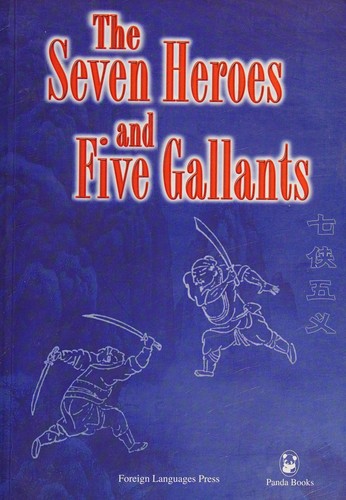
Why this book
This novel gave Chinese fiction its modern knight-errant: sworn brothers bound by loyalty, not birth, who serve justice outside the law — a template later wuxia epics and films would borrow for generations, from Judge Bao's courtroom shrewdness to Bai Yutang's reckless, glittering pride.
The Story
In the palace of a Song emperor, two consorts, Li and Liu, both carry his child, and only one heir can inherit — so Liu, desperate for the throne to fall to her, begins plotting long before either baby is born.
When Consort Li gives birth to a son first, Liu conspires with the palace eunuch Guo Huai: they smuggle in a skinned cat, swap it for the newborn prince in the birthing chamber, and accuse Li of birthing a monster.
Disgraced and condemned, Li is nearly strangled by her own attendants before a loyal eunuch smuggles her out of the palace instead, so she survives — but only by vanishing into exile, poor and unrecognized, believing her son is dead.
The true prince does not die either: he is secretly raised outside the palace, while Liu's own son is later presented as heir, so the throne itself now rests on a lie only a handful of conspirators know.
For years the secret holds: Liu's son is raised as heir, court records call Li's child a monster and nothing more, and the two eunuchs who know the truth choose silence over the executioner's blade that discovery would bring them.
Years later, a magistrate named Bao Zheng earns fame for a mind no bribe can bend and an eye no lie escapes; commoners call him Bao the Blue Sky, because his fairness feels as constant as daylight itself.
Bao Zheng does not work alone: his advisor Gongsun Ce reads law and precedent the way a physician reads pulse, and it is often Gongsun Ce's careful reasoning, not Bao's fame, that turns a hunch into evidence a court will accept.
Before Kaifeng, Bao served in smaller postings, and one case became legend: a farmer's ox was maimed by a rival, and Bao solved it not by torture but by trickery — inviting the guilty man to slaughter the ox himself and expose his motive.
Bao's reputation carries him to Kaifeng, the capital's own court, where even princes and eunuchs must answer his summons — and it is here, presiding over a beggar woman's strange complaint, that the old palace secret resurfaces.
The beggar is Consort Li herself, blind now and ragged, telling a story so wild that other judges dismissed her as mad — yet Bao listens, cross-questions her patiently, and recognizes a truth too consistent to be invented.
Where earlier judges heard a madwoman's rambling, Bao hears details too specific to fabricate — the exact chamber, the exact hour, the eunuch's own name — and orders the old palace records reopened despite decades of dust and official reluctance.
Bao reopens the twenty-year-old case, tracing the smuggled prince, the substituted cat, and the eunuch's confession, until the conspiracy collapses under its own witnesses — Guo Huai is executed, and Consort Liu's crime is laid bare before the throne.
The son Li lost is now the reigning emperor, and Bao arranges what no law required but justice demanded: mother and son are reunited, Li restored to her rightful honor, so a wrong sealed for two decades is finally undone.
Zhan Zhao had wandered as a masterless swordsman for years, taking no lord, until Bao's fairness — a magistrate who judged nobles as harshly as peasants — convinced him this was a court worth guarding, even before he was asked.
Bao's fearless verdicts earn him enemies among the corrupt, so when hired assassins slip into his residence one night, it is Zhan Zhao who intercepts the blades meant for the judge, moving faster than the killers can react.
Impressed, the emperor grants Zhan Zhao a title for his service: the Imperial Cat, protector of the court. Zhan Zhao means it as an honor, yet the name will soon reach ears far from the palace who take it as an insult.
In Chenzhou live five sworn brothers — outlaw swordsmen who call themselves the Five Rats — and among fighters, a cat is a rat's natural predator, so the new title lands like a challenge no one asked them to accept.
The youngest and proudest of them, Bai Yutang, refuses to let the insult stand quietly; where his older brothers weigh consequences, he simply acts, resolving to prove in the capital itself that no cat outoutmatches a rat.
Bai Yutang slips into the imperial palace under cover of night, past guards who never see him, and leaves behind a taunting note where only Zhan Zhao will find it — a signature instead of a theft, a challenge instead of a crime.
Zhan Zhao takes the bait: each time he tightens palace security, Bai Yutang finds a new gap to slip through, leaving another note, so what began as an insult becomes a private, wordless duel of skill neither man will admit he enjoys.
Bai Yutang's second break-in is bolder still: he leaves his note folded beside the pillow on Zhan Zhao's own sleeping robe, proof that no guard, however skilled, can watch every door in a palace built for a thousand rooms.
Two of the elder Rats, Lu Fang and Han Zhang, worry Bai Yutang's pride will get him killed chasing a grudge no one else cares about, but eldest-brother authority means little against a man convinced he is right.
Xu Qing and Jiang Ping side with caution too, yet all four know arguing rarely works — so instead they quietly begin watching the roads to the capital, ready to intervene if Bai Yutang's game turns into real danger.
Bao Zheng, intrigued rather than angered, orders his court to catch the thief without harming him, so when Bai Yutang is finally cornered, it is invitation instead of arrest — Bao wants to recruit him, not punish him.
Bai Yutang refuses to bow to a court cat, and a duel is arranged; the two fight to a standstill neither can call a win, which does more to earn Bai Yutang's respect than any lecture from his brothers could.
Recognizing a peer instead of a rival, Zhan Zhao offers his hand rather than his sword, so the rivalry that began with an insulting title ends instead in an unlikely friendship — cat and rat, sworn allies under Bao's banner.
One by one, the other four Rats follow Bai Yutang's lead, swearing themselves to Bao Zheng's court not as soldiers but as free knights-errant, bound by their own code rather than by rank, wages, or fear of punishment.
Together, Bao's knights turn Kaifeng into a court corrupt officials learn to dread: in one case, Zhan Zhao infiltrates a magistrate's own household to recover evidence of extortion buried beneath a false floor no ordinary inspector would find.
In another case, Jiang Ping's gift for disguise lets him pose as a lowly servant inside a bandit stronghold for weeks, quietly mapping its defenses from within, until Bao's raid succeeds swiftly and without a single innocent hostage coming to harm.
A third case tests loyalty over cunning: Han Zhang, gruff and blunt where Jiang Ping is subtle, poses as a hired thug to infiltrate a smuggling ring, and only his brothers' trust that he has not truly turned keeps Bao's court from moving against him too soon.
Case after case follows the same shape: cunning uncovers what brute force alone cannot, and Bao's knights consistently choose to outwit a criminal rather than kill him, a restraint that quietly separates them from the outlaws several of them once were.
A darker case surfaces: the Prince of Xiangyang, a royal cousin with old grievances against the throne, has been quietly stockpiling weapons and gold in his territory, and rumors reach Kaifeng that his ambitions reach far beyond his own province.
Worse, stolen imperial treasures — objects that symbolize the throne's own legitimacy — are traced directly to Xiangyang's stronghold, so recovering them quietly becomes both an ordinary criminal case and, underneath, a defense against something that looks closer to rebellion.
Bao dispatches his knights to scout Xiangyang's territory in strict secrecy, since an open imperial investigation would only warn the prince and let him hide or destroy the evidence long before anyone official could act against him.
What they find is worse than stockpiled gold: Xiangyang has built a fortress laced with hidden traps, engineered specifically to kill any intruder who gets past its outer walls — a stronghold designed for war, not mere hoarding.
Jiang Ping, the Rats' best swimmer and infiltrator, spends three nights charting Xiangyang's water defenses alone, diagram by diagram, until Bao's knights understand the fortress well enough to know just how dangerous entering it uninvited would be.
Bai Yutang, still proudest of the knights, decides the honor of retrieving the treasure should be his alone; his brothers argue he is being reckless again, but this time Bao himself is away, and no one can talk him out of it.
Even Gongsun Ce, reading Jiang Ping's diagrams back in Kaifeng, sends word that the fortress should be reported to the throne and stormed properly, not entered quietly — but the warning arrives after Bai Yutang has already decided, and pride does not wait for letters.
Against caution, Bai Yutang slips into Xiangyang's fortress at night exactly as he once slipped into the imperial palace — confident, unhurried, certain that the same skill that embarrassed the Imperial Cat will be enough here too.
But this fortress was built to punish exactly that confidence: deep inside, Bai Yutang triggers the Copper Net Formation, a chamber rigged with hooked blades and snapping wires that close on him from every side at once.
He fights the trap as he has fought every danger before, refusing to call for help until refusing is no longer a choice — the hooks close, and Bai Yutang, the proudest of the Five Rats, dies alone inside the net he could not out-maneuver.
Word reaches his sworn brothers before it reaches Bao: the fortress still stands, the Prince of Xiangyang is neither captured nor stopped, and the rebellion they were sent to investigate remains exactly as dangerous as the day they first heard of it.
Zhan Zhao, who once dueled Bai Yutang to a standstill and called him brother afterward, is the one who carries the news back to the other four Rats — and for the first time since the palace rooftops, the Imperial Cat has nothing clever left to say.
Lu Fang, Han Zhang, Xu Qing, and Jiang Ping mourn a brother whose pride finally cost him everything, yet none of them speak of quitting; the fight against Xiangyang is unfinished, and unfinished is exactly how the story leaves it.
What it means
Seven Heroes and Five Gallants never promises its heroes a clean victory — it argues instead that justice is built case by case, brother by brother, and that courage without humility, however dazzling, eventually meets a trap pride alone cannot escape.
🎧 Read-along audio is being prepared — text-only for now.