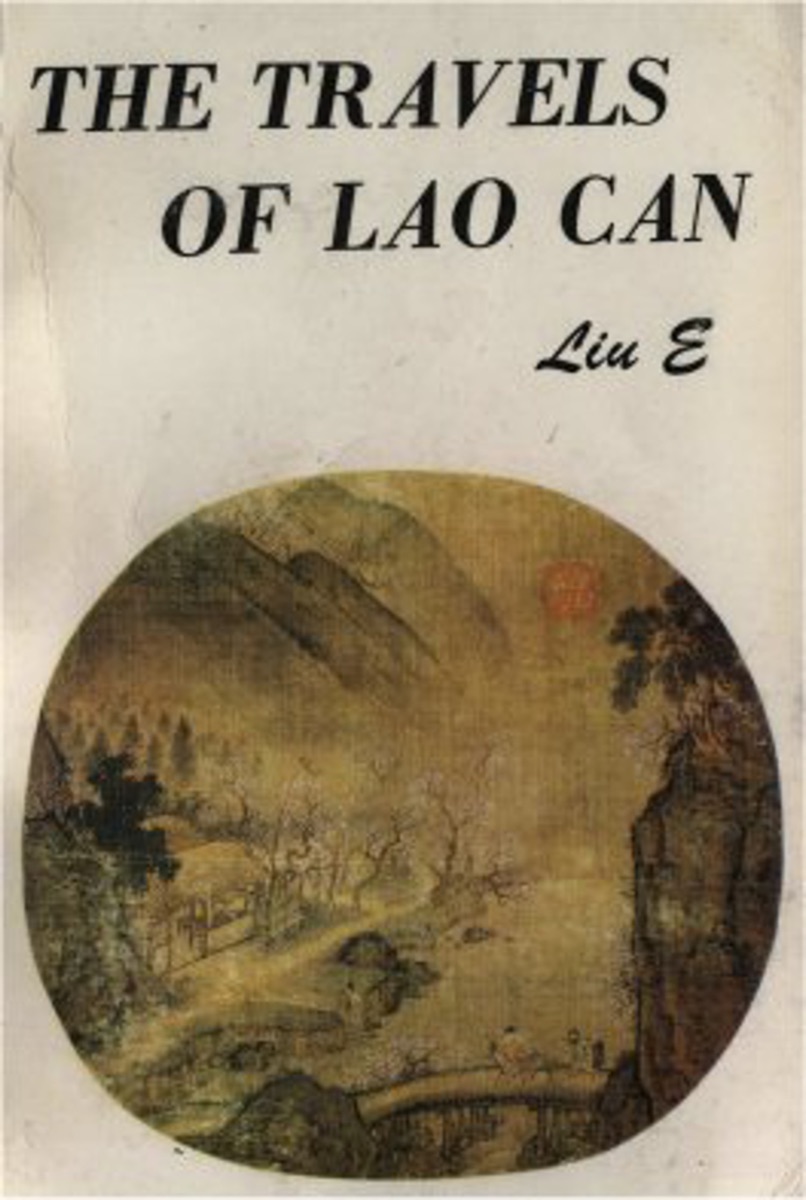
Why this book
Published in 1904, The Travels of Lao Can gave Chinese literature a startling new kind of villain: not a thief or bribe-taker, but an incorruptible official whose righteousness kills — cruelty wearing a spotless conscience, more dangerous than any bandit.
The Story
Lao Can once studied for the imperial examinations. He failed, and when his father died soon after, poverty followed close behind — so a wandering Daoist teacher took him in, and taught him to heal not by rote herb-lists, but by watching how a body, like a river, needs guiding, never damming.
His methods work where ordinary physicians fail: he cures his old friend Huang Renrui's stubborn illness with an engineer's patience instead of a pharmacist's recipe book. Word of the cure spreads quickly, and Lao Can takes to the road for good, now a healer who reads a troubled town as carefully as he once read a pulse.
His travels become a kind of map of their own — not of roads, but of how power is used in each town he passes through, sometimes healing, sometimes cruel. Unhurried, Lao Can learns to tell the difference, and to act on exactly what he finds.
In Jinan he lingers by the great springs, watching clear water boil up endlessly through stone — proof, he quietly thinks, that even a buried, choked place can still find a way through, given the right channel to follow.
In Caozhou he hears of Prefect Yu Xian — utterly unbribable, tireless against banditry, and merciless. To stamp out crime, Yu Xian locks mere suspects into a standing cage that kills slowly, by exhaustion and thirst, and he never once doubts that he is right to do it.
One family paid for that certainty: a father and his two sons, caged and killed on suspicion alone, with no trial and no real proof against them. Rather than watch her husband die that slow way, the young wife inside the family chose to end her own life first.
A neighboring magistrate, frightened of bandits himself, begs Lao Can for help before he too resorts to cages. Instead, Lao Can proposes Liu Renfu — a reclusive former monk who lives by the road's own unwritten code and can guard a whole county without killing anyone.
Through a heavy winter snowfall, Lao Can writes urgently to the provincial governor, defending Yu Xian's severity against bandits yet pleading for restraint — since even honest cruelty, left unchecked long enough, becomes a crime of its own.
He writes to Liu Renfu too, appealing to an old debt of honor between them. It works: Liu Renfu accepts the post, and the county gains a guardian who protects its people without adding a single body to the dead.
In the provincial capital, well-placed officials offer Lao Can a purchased title — pay the right sum, and wear the rank for life. He wants no office bought that cheaply, so he slips away by night rather than trade his freedom for a borrowed name.
Winter ice seals the Yellow River at Qihe, stranding him there for weeks — which is how he finds his old friend Huang Renrui again, still generous, still eager to host a tired traveler at his own table.
Among the singing girls at that table sits one, Cuihuan, who flinches whenever a sleeve rides up over old whip scars she tries to hide. Lao Can notices what the rest of the room has learned to ignore.
Cuihuan was once a merchant's daughter, until officials in charge of flood control tore out the river's protective dikes without paying to relocate a single family living behind them. Her own family was ruined overnight, and she was sold into this house simply to survive.
She recites a bitter little poem about a caged bird whose keeper calls it lucky — and for a moment, the table's easy chatter stops, and even Huang Renrui, usually quick with words, has none.
Moved by her story, Lao Can and Huang Renrui resolve together to buy Cuihuan's freedom outright — not as one more customer's passing whim, but as two old friends refusing to let another ruined family go completely unanswered.
Huang Renrui then tells him of a graver wrong still unfolding. A mooncake laced with poison had killed a household, and a merchant family was blamed for it, tortured again and again until they confessed to a crime they never actually committed.
The special investigator running the case, Gang Bi, needs no real proof — only fear does the work for him. He sets an open price on innocence itself: five hundred taels for each life, sixty-five hundred to spare the family whole.
The family scrapes together what little money they still have, but even a partial payment buys only a delay, never real mercy — and every single day they remain in custody, confessions already beaten out of them harden further into official 'fact.'
One witness sealed their fate before the trial even began: a young man named Jia Gan, sheltered for years by the very family he now testified against — paid, Lao Can suspects, to point anywhere but toward his own kin.
Appalled, Lao Can petitions the governor directly, laying out everything he has learned. Convinced, the governor sends an incorruptible censor, Bai Gong, to retry the whole case in Qihe — the family's one real chance left at justice.
Bai Gong proves himself thorough. He compares the poisoned mooncake to two untouched ones the family had quietly hidden away, and to a fresh one from the same bakery — identical in every way, except for the poison added afterward, by someone else's hand.
Lao Can sends a constable undercover to trace the poison to its actual source. The trail leads to a vagabond named Wu Er, who had sold a rare and potent arsenic draught just days before the poisoning happened.
A reclusive mountain alchemist gives Lao Can the exact antidote. He uses it to save a daughter of the accused family, still failing from that same poison — living proof of precisely what killed the others, and where it truly came from.
The truth finally breaks open: Wu Er's lover, Jia Danizi, turns out to be Jia Gan's own sister. She had forced her brother into his false testimony to hide her and Wu Er's crime — and the accused family is innocent of everything.
Gang Bi's bribes and false tortures collapse alongside the real killers' own confessions. The merchant family walks free at last, reunited and whole — saved not by luck or connections, but because one traveling doctor refused to let a false verdict stand unchallenged.
What it means
Yu Xian's cage and Gang Bi's frame-up wear entirely different faces — one cruel with a clean conscience, one greedy behind an official seal — yet both kill through power that nobody checks. Lao Can's gift is smaller and far rarer: patient, stubborn truth, carried town to town, one case at a time.
🎧 Read-along audio is being prepared — text-only for now.